
How to Calculate HPP Machine Productivity
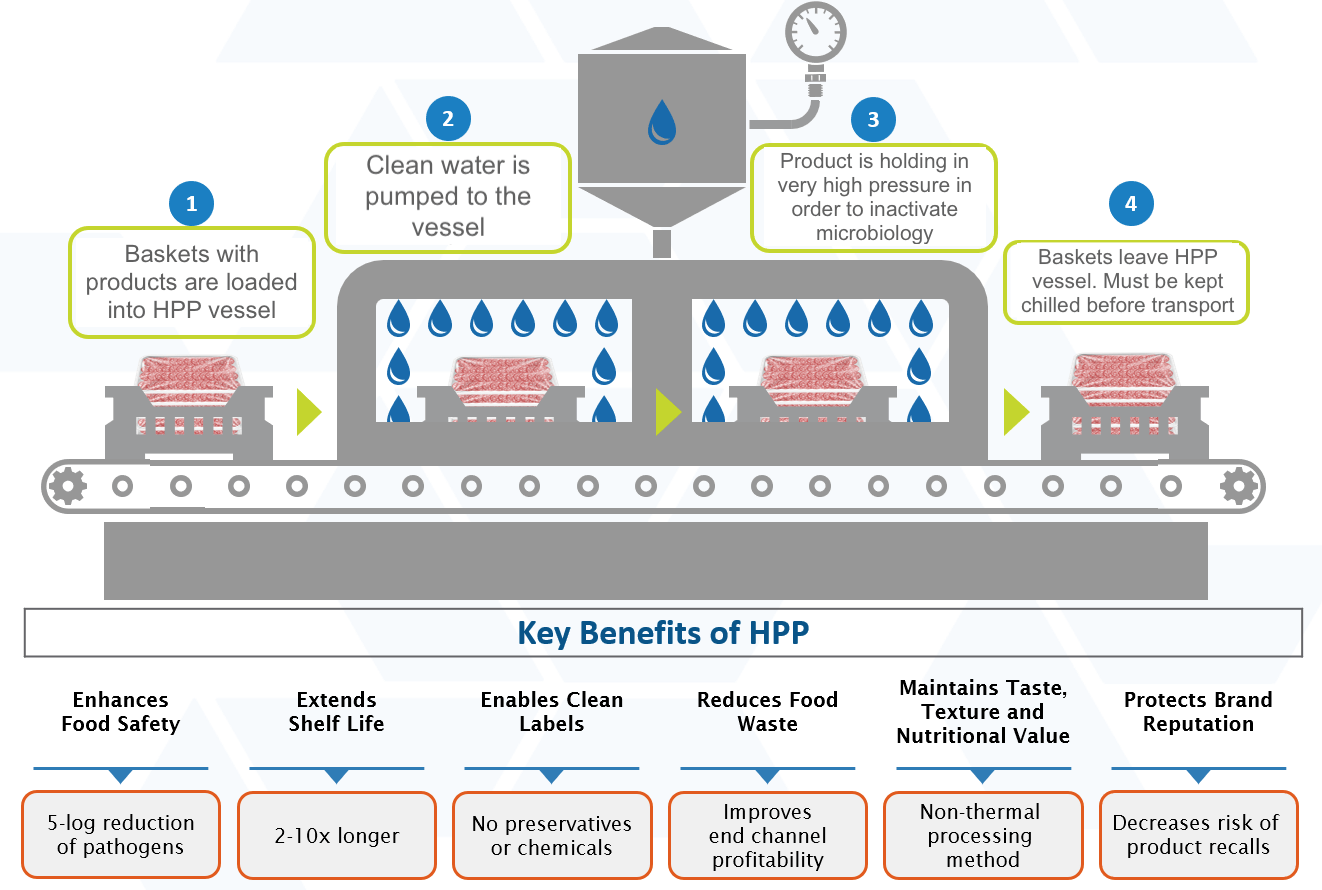
High Pressure Processing (HPP) systems operate in batch cycles, meaning each vessel load is pressurized, held for a specific time, and unloaded before the next cycle begins. The total production capacity depends on three main variables:
-
Vessel volume (net liters)
-
Effective filling ratio (50–70%)
-
Number of cycles per hour (typically 6–8)
Because most food and beverages have a density close to water (1 kg ≈ 1 L), production can be estimated in either liters or kilograms. Below, we explain how to calculate capacity for each machine size group used in industrial and laboratory HPP applications.
1. Laboratory and Pilot Systems
(our suggestion is 3 – 30 L)
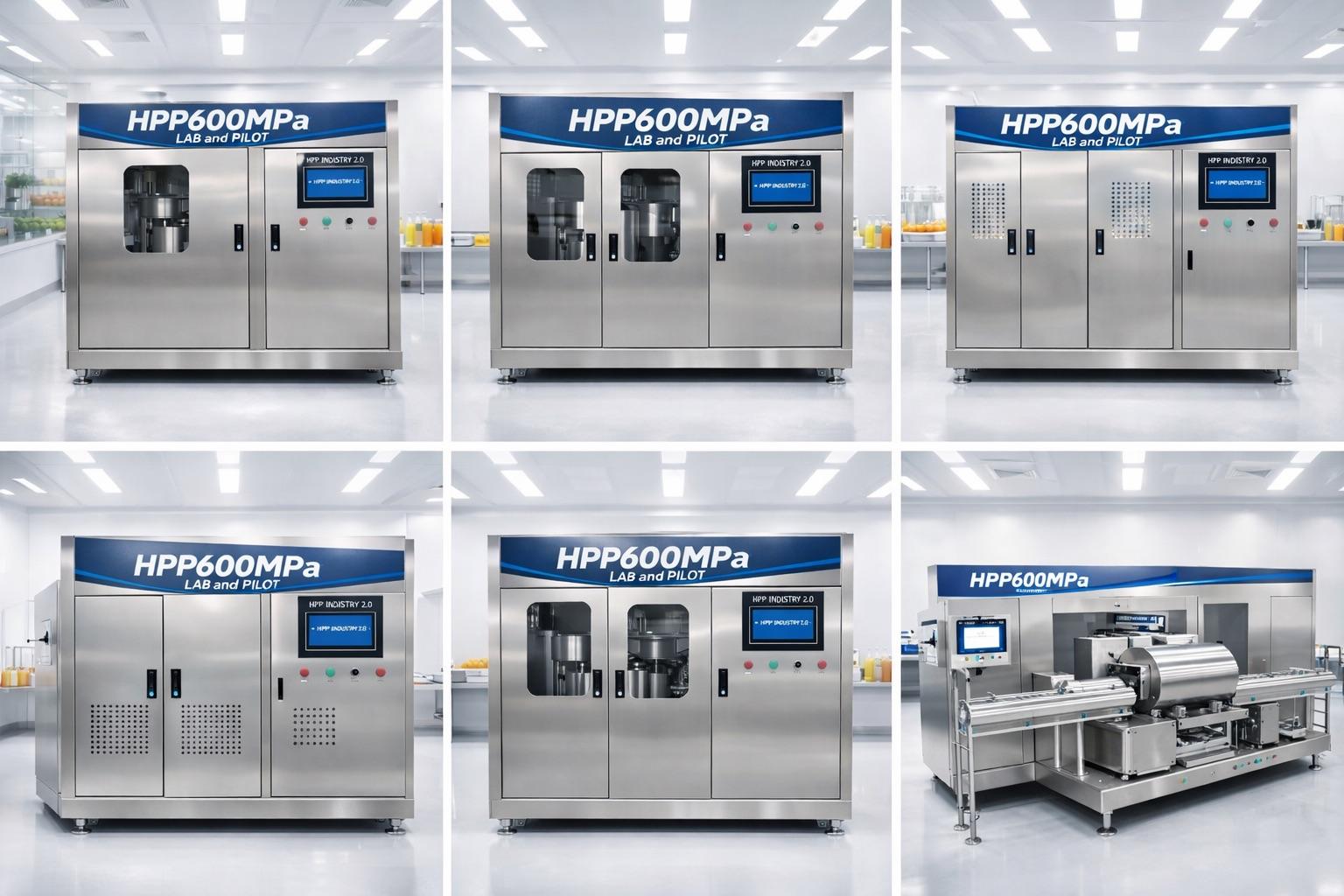
These compact machines are ideal for R&D, quality testing, and small pilot production. They share a cycle time of about 7–10 minutes (6–8 cycles/hour) and working pressure up to 600 MPa.
Calculation Formula
Capacity = Vessel Volume × Filling Ratio × Cycles per Hour
Estimated Productivity (3–30 L Models)
| Machine Volume (L) | Filling 50% (kg/h) | Filling 60% (kg/h) | Filling 70% (kg/h) |
|---|---|---|---|
| 3 L | 90–120 | 108–144 | 126–168 |
| 5 L | 150–200 | 180–240 | 210–280 |
| 10 L | 300–400 | 360–480 | 420–560 |
| 15 L | 450–600 | 540–720 | 630–840 |
| 30 L | 900–1,200 | 1,080–1,440 | 1,260–1,680 |
Example: a 10 L lab HPP at 70% fill and 8 cycles/h delivers about 560 kg/h.
2. Medium-Scale Production Systems
(our suggestion 15 L – 100 L)
These machines suit small and medium food producers processing sauces, juices, dairy, seafood, or ready meals. Cycle time remains about 7 min, giving 6–8 cycles/h.
Calculation Formula
Capacity = Vessel Volume × Filling Ratio × Cycles per Hour
Estimated Productivity (15–100 L Models)
| Machine Volume (L) | Filling 50% (kg/h) | Filling 60% (kg/h) | Filling 70% (kg/h) |
|---|---|---|---|
| 15 L | 450–600 | 540–720 | 630–840 |
| 30 L | 900–1,200 | 1,080–1,440 | 1,260–1,680 |
| 50 L | 1,500–2,000 | 1,800–2,400 | 2,100–2,800 |
| 100 L | 3,000–4,000 | 3,600–4,800 | 4,200–5,600 |
Example: A 50 L unit filled to 60% and operating 7 cycles/h achieves around 2,100 kg per hour, suitable for medium beverage producers.
3. Industrial Production Systems
(our suggestion 100 L – 600 L and Dual-Vessel Units)
Large-scale HPP systems such as 100 L, 200 L, 300 L, dual 2×200 L, 525 L, and dual 2×300 L are designed for continuous operation.
Dual-vessel systems can process one load while unloading the other, maximizing uptime and reducing idle time.
Calculation Formula
Capacity = Vessel Volume × Filling Ratio × Cycles per Hour
Estimated Productivity (100–600 L and Dual Systems)
| Machine Model | Total Vessel Volume (L) | Filling 50% (kg/h) | Filling 60% (kg/h) | Filling 70% (kg/h) |
|---|---|---|---|---|
| 100 L | 100 | 3,000–4,000 | 3,600–4,800 | 4,200–5,600 |
| 200 L | 200 | 6,000–8,000 | 7,200–9,600 | 8,400–11,200 |
| 300 L | 300 | 9,000–12,000 | 10,800–14,400 | 12,600–16,800 |
| 2×200 L | 400 | 12,000–16,000 | 14,400–19,200 | 16,800–22,400 |
| 525 L | 525 | 15,750–21,000 | 18,900–25,200 | 22,050–29,400 |
| 2×300 L | 600 | 18,000–24,000 | 21,600–28,800 | 25,200–33,600 |
Example: A 2×300 L HPP with 70% fill and 7 cycles/h can process roughly 33 t per hour, depending on product type and packaging.
Key Takeaways
-
Cycle time ≈ 7 minutes including filling, pressure hold, and unloading (pressurizing time 0-600MPa=2-3min). Cycle time means f.eg. 3min pressurizing, 3 minutes holding and 1 minutes depressurizing.
-
Cycles per hour: our machinery can do typically 6–8 cycles per hour (it is depend from above)
-
Filling ratio: best efficiency at 60–70% of vessel volume. We calculate 50-70% and this depend only from size and shape of you product which you put into our perforated basket).
-
Density: food and liquid products can be compared 1:1 in L/kg
Our HPP machines maintain the same 600 MPa pressure, 2–3 min compression time, and 6–8 cycles/h performance across all models, from 3 L laboratory systems to 600 L industrial lines, ensuring scalable productivity for every size of food producer.